

Section 07
7Vibe Orchestration and the Cognitive Security Stack
In vibe orchestration, AI is persistent: it makes decisions, executes logic and manages environments. This exposes a new threat surface — the cognitive layer. Cognitive security is the discipline of protecting that layer, and the human operating system around it, from manipulation, deception and systemic disruption.
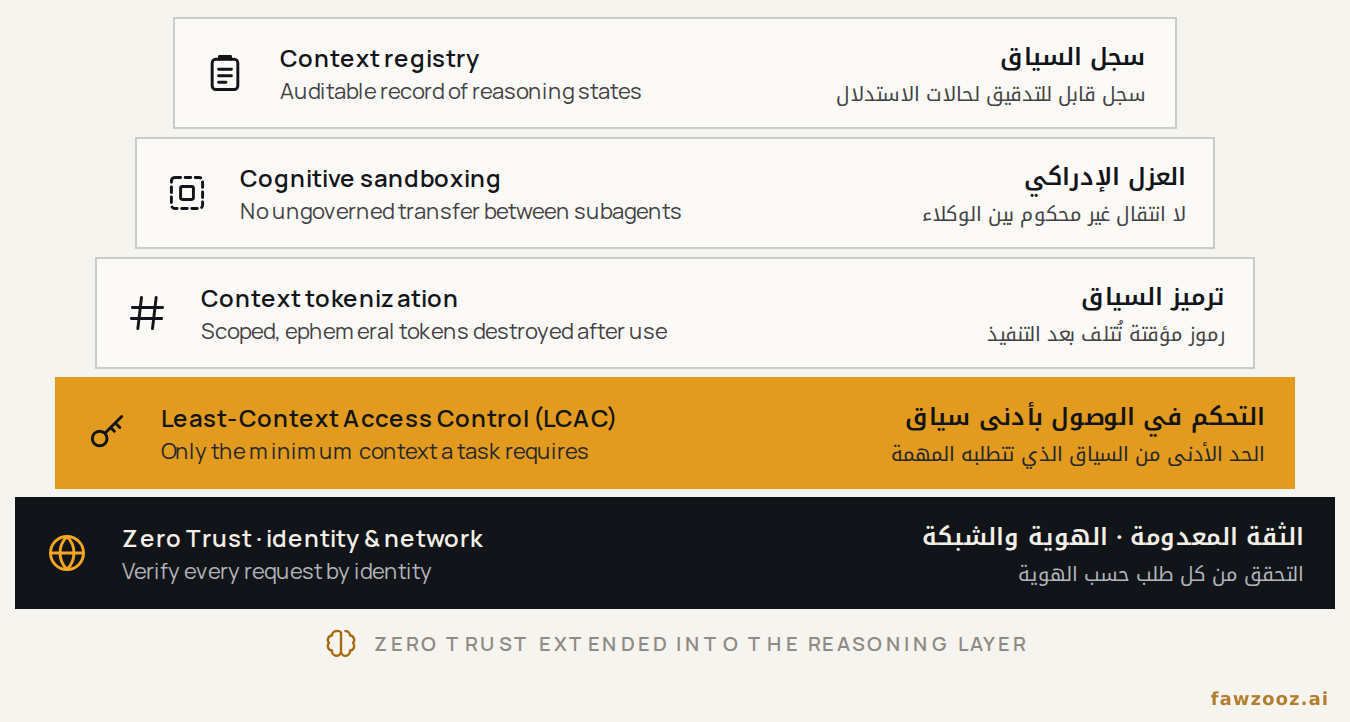
- Context tokenization. Prompts, system files and retrieval vectors are broken into scoped, ephemeral tokens, so data stays isolated and is destroyed after execution.
- Cognitive sandboxing. Prevents the ungoverned transfer of knowledge, intent or system variables between subagents, mitigating data drift and cross-context bias.
- Context registry. Logs the model’s reasoning states and decision paths without storing sensitive prompt content, giving an unalterable, auditable record of the AI’s “thought process”.
Text in this figure
Context registry · Auditable record of reasoning states · Cognitive sandboxing · No ungoverned transfer between subagents · Context tokenization · Scoped, ephemeral tokens destroyed after use · Least-Context Access Control (LCAC) · Only the minimum context a task requires · Zero Trust · identity & network · Verify every request by identity · ZERO TRUST EXTENDED INTO THE REASONING LAYER
Core concept · The question is no longer who can act, but what an agent can know
Zero Trust verifies every request and restricts privilege by identity — insufficient for AI that reasons, reflects and writes its own logic. LCAC extends Zero Trust into the reasoning layer by restricting the data supplied to a model’s context to the absolute minimum a task requires, preventing context leakage and manipulation.
Tip: use ← → to move between sections.