

Section 01
1Introduction: Two Converging Shifts
The rapid democratization of AI has fundamentally altered how enterprise applications are conceived, prototyped and deployed. Alongside sanctioned corporate initiatives, employees seeking to optimize their workflows and overcome bureaucratic friction have produced ‘shadow AI’: the unsanctioned use of AI tools, large language models (LLMs) and cognitive services embedded directly into organizational processes. These localized tools are a powerful engine of innovation — but kept hidden, they introduce severe operational, data-security and compliance vulnerabilities.
At the same time, the relationship between developer and machine is being re-engineered. AI has moved from a passive typing utility inside the IDE to an active orchestrator of multi-agent workflows. The two shifts are one phenomenon seen from two sides: shadow AI changes who builds software; vibe orchestration changes how it is built. Governing either in isolation leaves the other ungoverned.
Shadow AI extends far beyond classic shadow IT. Shadow IT involves unauthorized deterministic software, with risks of billing sprawl, access management and static data exposure. Shadow AI is a failure of cognitive and data governance: an opaque supply chain of third-party models with uncertain provenance, and generative systems that process, store and sometimes train on proprietary inputs. Developers routinely paste proprietary source code into unsanctioned chatbots to debug scripts, moving intellectual property outside the perimeter.
Text in this figure
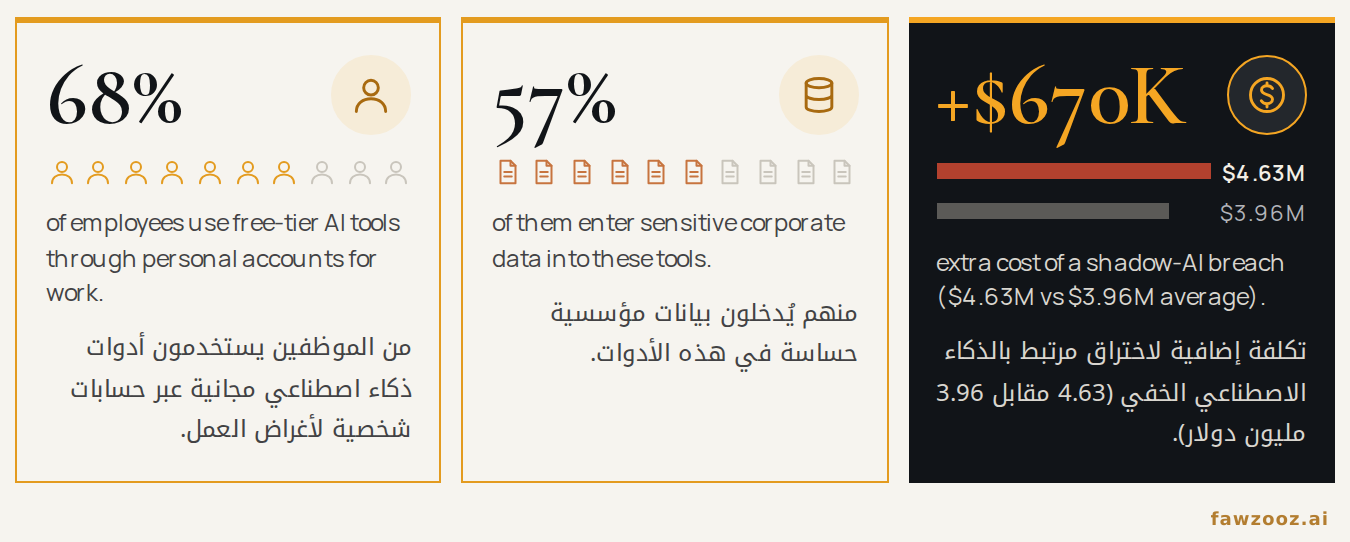
68% · of employees use free-tier AI tools through personal accounts for work. · 57% · of them enter sensitive corporate data into these tools. · +$670K · $4.63M · $3.96M · extra cost of a shadow-AI breach ($4.63M vs $3.96M average).
Because bans fail, the objective is no longer to eradicate shadow AI but to transition it into a formalized, observable and compliant pipeline — while expanding the security paradigm beyond static code analysis to cognitive security. This requires a synthesis of technical architecture and organizational psychology, which the rest of this paper develops.
Text in this figure
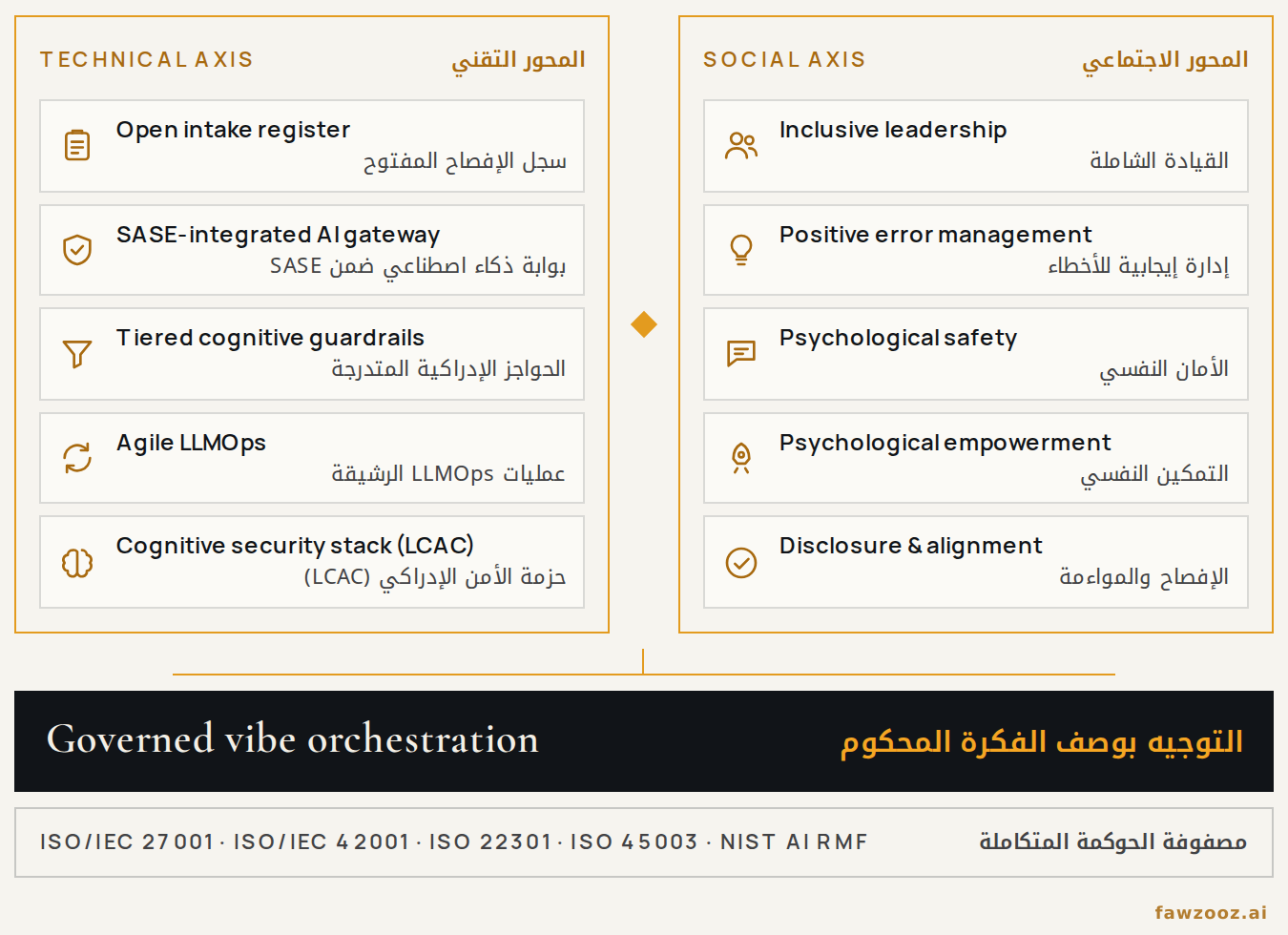
TECHNICAL AXIS · Open intake register · SASE-integrated AI gateway · Tiered cognitive guardrails · Agile LLMOps · Cognitive security stack (LCAC) · SOCIAL AXIS · Inclusive leadership · Positive error management · Psychological safety · Psychological empowerment · Disclosure & alignment · Governed vibe orchestration · ISO/IEC 27001 · ISO/IEC 42001 · ISO 22301 · ISO 45003 · NIST AI RMF
Tip: use ← → to move between sections.