

SECTION 04
04Why a new model?
The frameworks in use today are good. They just were not built for systems that learn. Each assumes a system behaves the way its documentation says. A learning system does not: its data changes, so its behaviour changes.
UCSMM sits on top of existing frameworks and adds the missing cognitive layer: the capability to protect systems that learn — data integrity, model robustness, behaviour after deployment, and the trust an inference deserves. It borrows the frameworks' language and does not compete with them.
| FRAMEWORK | COVERS · STOPS AT |
|---|---|
| ISO/IEC 27001 | Whether a control exists Not how intelligent it is; data integrity and model robustness are not assets in their own right. |
| NIST CSF | Defined, stable assets A learning model is an asset whose behaviour changes after deployment. |
| CMMI | Process consistency Designed for software processes: the procedure matures, the reasoning does not. |
| Zero Trust | Who gets in Not whether a model's inference deserves trust; an authorised agent stays authorised while it is being misled. |
| AI governance | Ethics and compliance Rarely adversarial behaviour, and rarely connected to security operations. |
Each framework assumes a system that behaves as described. The cognitive layer is absent from all five; UCSMM is added on top of an existing programme, not in place of it.
The core logic
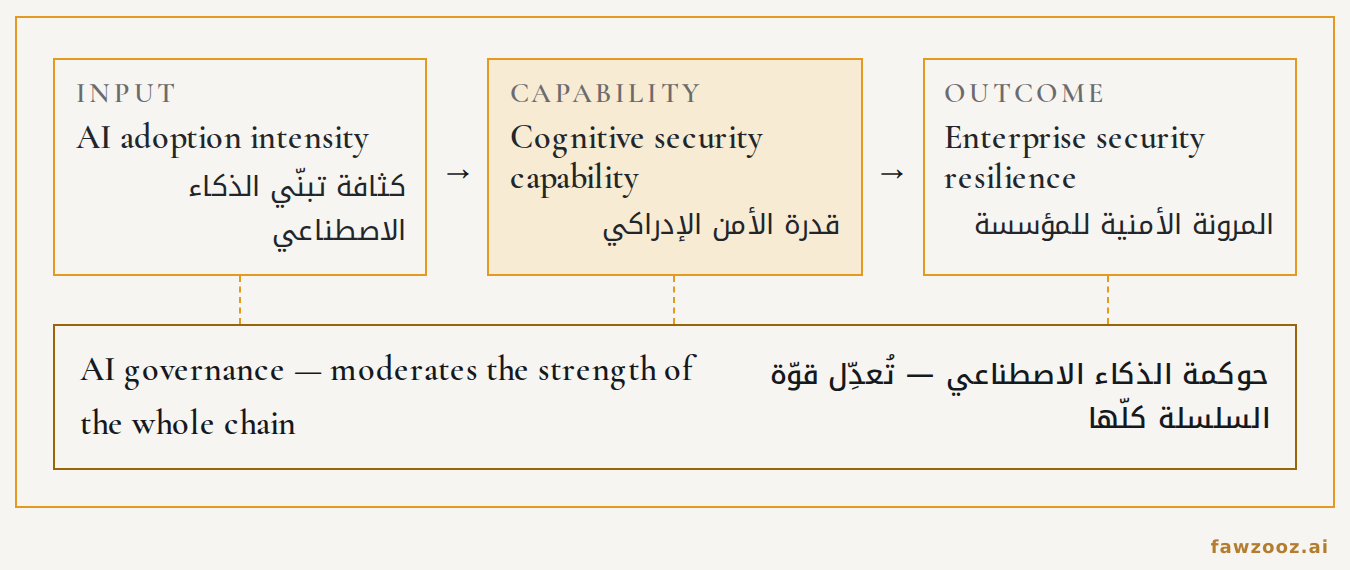
Buying AI does not make an organisation resilient. Building the capability to protect it does. Adopting AI first makes security more complex. That complexity only turns into resilience when the organisation builds the capability to protect its intelligent systems — and good governance is what makes that conversion work. This is what the quantitative research behind the model found, across sectors.
Text in this figure
INPUT · AI adoption intensity · → · CAPABILITY · Cognitive security capability · → · OUTCOME · Enterprise security resilience · AI governance — moderates the strength of the whole chain
Adoption raises complexity; capability converts it into resilience; governance sets how efficiently the conversion works.
Why “unified”?
Because four capability dimensions are measured inside one structure. An organisation that invests in intelligent detection without governance builds a capability nobody has the authority to turn into a decision; one that writes governance without detection produces policies with no evidence of enforcement.
Real maturity is balanced, and the imbalance between dimensions is the most important thing an assessment reveals. An organisation rarely needs to know “how mature we are” so much as which dimension is dragging it down.
Tip: use ← → to move between sections.