

Section 3
3The InnovaForge Framework
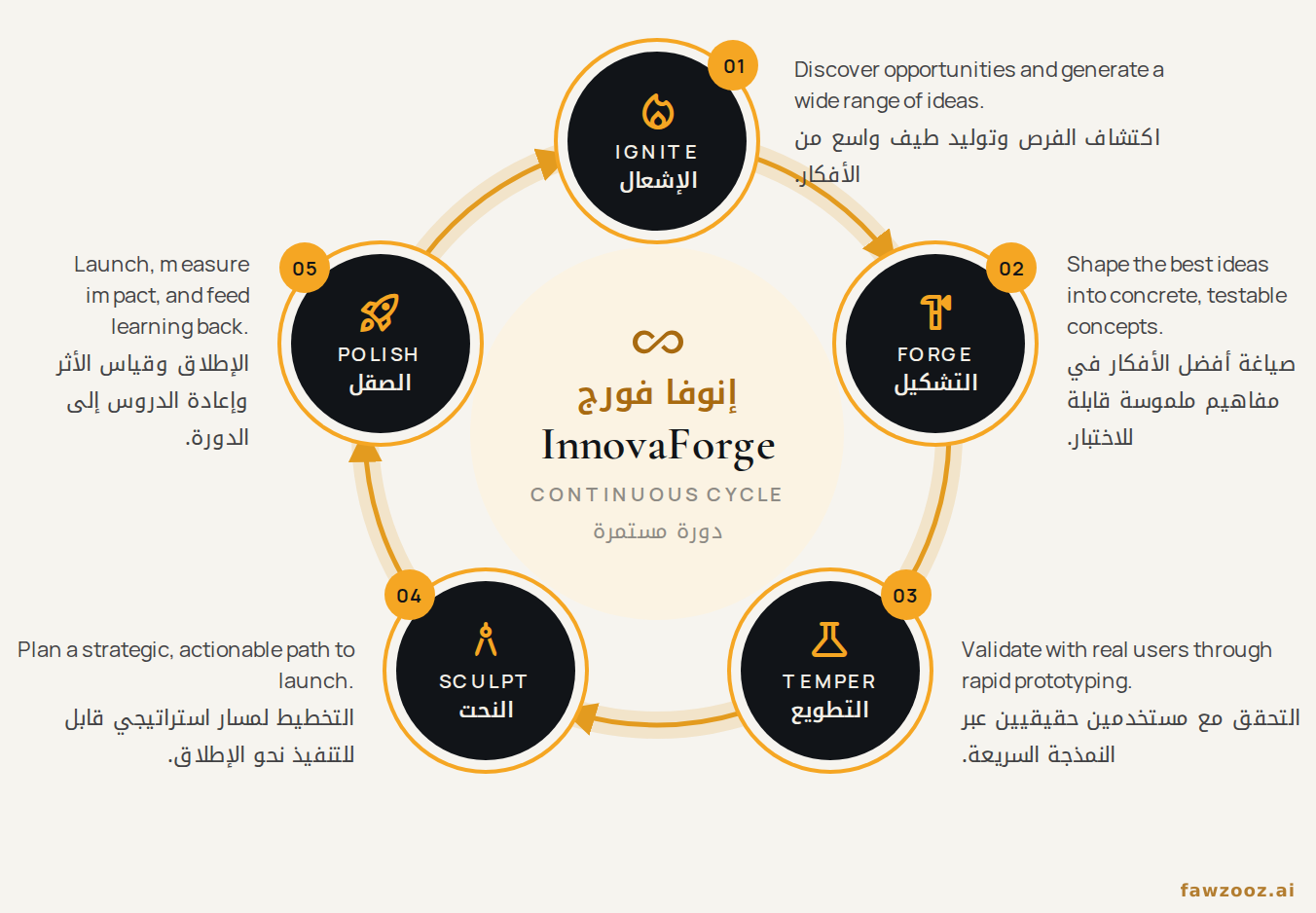
InnovaForge consists of five dynamic, iterative stages that form a continuous cycle of improvement. It is released under an open licence so that any team, school or institution can adopt and adapt it.
Text in this figure
InnovaForge · CONTINUOUS CYCLE · IGNITE · 01 · Discover opportunities and generate a wide range of ideas. · FORGE · 02 · Shape the best ideas into concrete, testable concepts. · TEMPER · 03 · Validate with real users through rapid prototyping. · SCULPT · 04 · Plan a strategic, actionable path to launch. · POLISH · 05 · Launch, measure impact, and feed learning back.
Guiding principles
Collaborate with purpose
Innovation is a team sport. Psychological safety and diverse perspectives, from engineering to marketing to customer support, produce stronger ideas.
Embrace iteration
Failure is data, not an endpoint. Every prototype and failed experiment informs the next step.
Adapt and evolve
A guide, not a rigid process. Stages and tools scale to the size, context and constraints of each project.
STAGE 01 OF 05
Ignite
The Spark of Insight
- Objective
Move from broad curiosity to a specific, well-defined problem or opportunity worth exploring.
Core action
Identify opportunities
- Activities. Problem finding beneath surface issues; inspiration mining across reports, competitors, customers and unrelated fields; and open, judgment-free brainstorming.
- Techniques. Brainstorming, the 5 Whys, Provocation.
- Exit criteria. One to three prioritized problems or opportunities and a bank of initial ideas, recorded on the canvas.
STAGE 02 OF 05
Forge
Shaping the Concept
- Objective
Transform raw ideas into structured, testable concepts with a clear value proposition.
Core action
Define the value proposition
- Activities. Concept statements that define purpose, audience and features; a thirty-minute Lean Canvas; and low-fidelity prototypes such as sketches, wireframes or a “future press release”.
- Techniques. SCAMPER, TRIZ, Mind mapping.
- Exit criteria. A clear value proposition and a low-fidelity prototype ready for first feedback.
STAGE 03 OF 05
Temper
Testing and Iteration
- Objective
Expose the concept to real-world feedback and data, strengthening it through rapid cycles of learning.
Core action
Validate with users
- Activities. Build a minimum viable product; run interviews, analytics, A/B and usability tests with five to ten users per cycle; iterate or pivot on evidence through Build–Measure–Learn.
- Techniques. Design Thinking, Storyboarding.
- Exit criteria. Core assumptions validated or invalidated with real user data; learnings and pivots recorded.
STAGE 04 OF 05
Sculpt
Planning for Impact
- Objective
Create a clear, actionable, strategic roadmap for developing and launching the validated solution.
Core action
Create an actionable roadmap
- Activities. Strategic alignment with the mission; agile planning in user stories and sprints with OKRs and a three-to-six-month roadmap; resources, budget and a simple risk matrix.
- Techniques. SWOT analysis, Six Thinking Hats.
- Exit criteria. A roadmap with objectives and success metrics agreed by the team and stakeholders.
STAGE 05 OF 05
Polish
Launch, Learn, and Scale
- Objective
Execute the plan, measure real-world impact, and embed the learnings back into the organization.
Core action
Deliver, measure, and learn
- Activities. A full or phased launch guided by a checklist; tracking the OKRs and KPIs set in Sculpt; and a retrospective two to four weeks after launch: what worked, what did not, what we learned.
- Exit criteria. Initial performance data analyzed and a decision taken: iterate, scale or sunset. The cycle begins anew.
Tip: use ← → to move between sections.